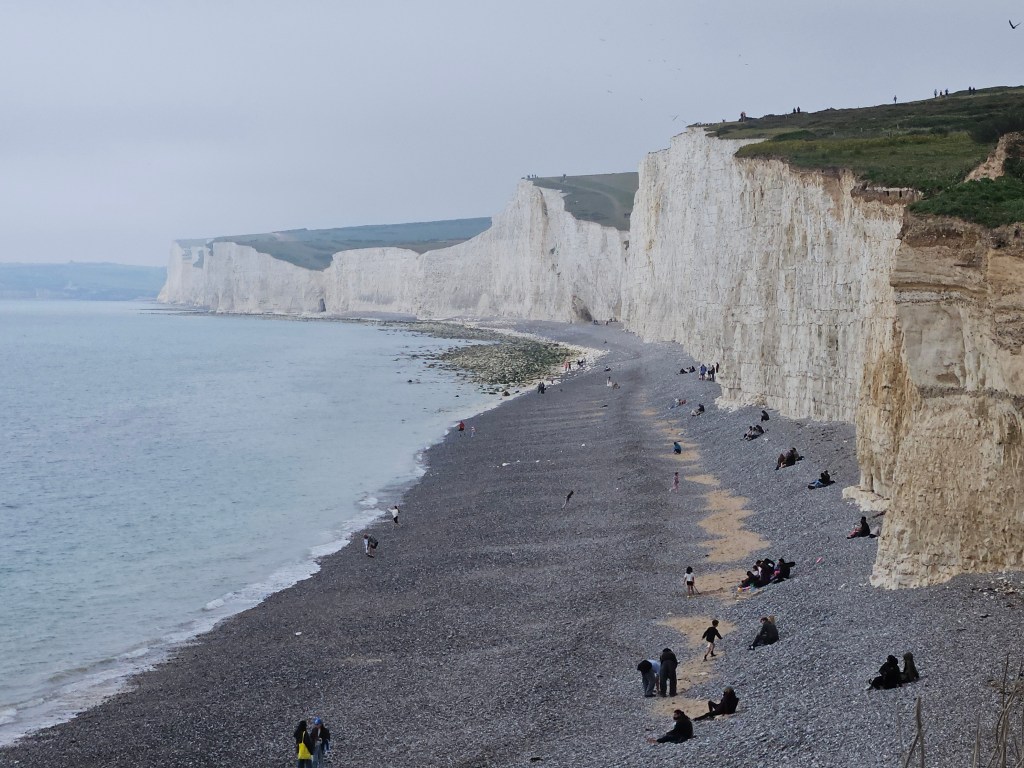
The Seven Sisters are the kind of place that make you feel very small in the best possible way.
They sit on the East Sussex coast, between Seaford and Eastbourne, where the South Downs meet the English Channel in a long sweep of white chalk cliffs, shingle beach, rock pools and open sky. The section I visited was around Birling Gap, which is managed by the National Trust and is one of the best-known access points for seeing the cliffs up close. The National Trust describes Birling Gap and the Seven Sisters as part of one of the longest stretches of undeveloped coastline on the south coast. (National Trust)
And they are not just pretty cliffs.
They are ancient.
The chalk here dates from the Late Cretaceous period, roughly 87 to 84 million years ago. At that time, this part of the world was not cliffs and sheep and walkers in sensible shoes. It was a warm, shallow sea. Tiny marine organisms lived, died, sank to the seabed, and over millions of years their remains were compressed into the chalk we see today. (discoveringfossils.co.uk)
So yes, standing there looking at those white cliffs, you are looking at the remains of an ancient sea.
This chalk was forming in the age of dinosaurs. That’s the part that makes my brain stop for a second. Not humans. Not castles. Not England as we know it. Dinosaurs.
Fossil teeth found in East Sussex showed that spinosaurs, tyrannosaurs and relatives of Velociraptor once lived along what is now England’s south coast. (nhm.ac.uk)
The Seven Sisters chalk is younger than those Sussex dinosaur finds, dating to the Late Cretaceous, around 87 to 84 million years ago, when this area was covered by a warm, shallow sea. Tiny marine organisms lived, died, sank to the seabed, and over millions of years their remains were compressed into the chalk cliffs we see today. (discoveringfossils.co.uk)
That’s what makes the cliffs more than just a pretty view. You’re standing between two huge stories: Sussex’s dinosaur past, and an ancient sea that later became white cliffs, rock pools and chalk under your feet.
The Seven Sisters themselves are a series of chalk sea cliffs shaped by erosion from the English Channel. They form part of the South Downs, and the famous cliff line runs near the Cuckmere Valley, Birling Gap, Belle Tout, and Beachy Head. (Wikipedia)
The name comes from the distinct cliff peaks. Depending on how they are counted, you may see seven or eight listed, because erosion has changed the coastline over time. The commonly named Sisters include:
- Haven Brow
- Short Brow
- Rough Brow
- Brass Point
- Flagstaff Point
- Flat Hill
- Baily’s Hill
- Went Hill Brow
The official Seven Sisters Country Park site notes that, despite the name, there are now actually eight Sisters. That feels very on-brand for a coastline that refuses to stay still. (Seven Sisters)
From the beach at Birling Gap, the cliffs feel massive. From above, they roll along the coast in those clean white folds that make them look almost too neat to be real. But up close, the chalk is rough, cracked, layered and constantly changing.
That changing part matters.
The cliffs are actively eroding. Chalk falls can happen without warning, and the official safety advice is to stay away from both the cliff edge and the cliff base. When you see fallen chalk at the bottom of the cliffs, it is not just scenery. It is the landscape still moving. Slowly most days. Suddenly on others.
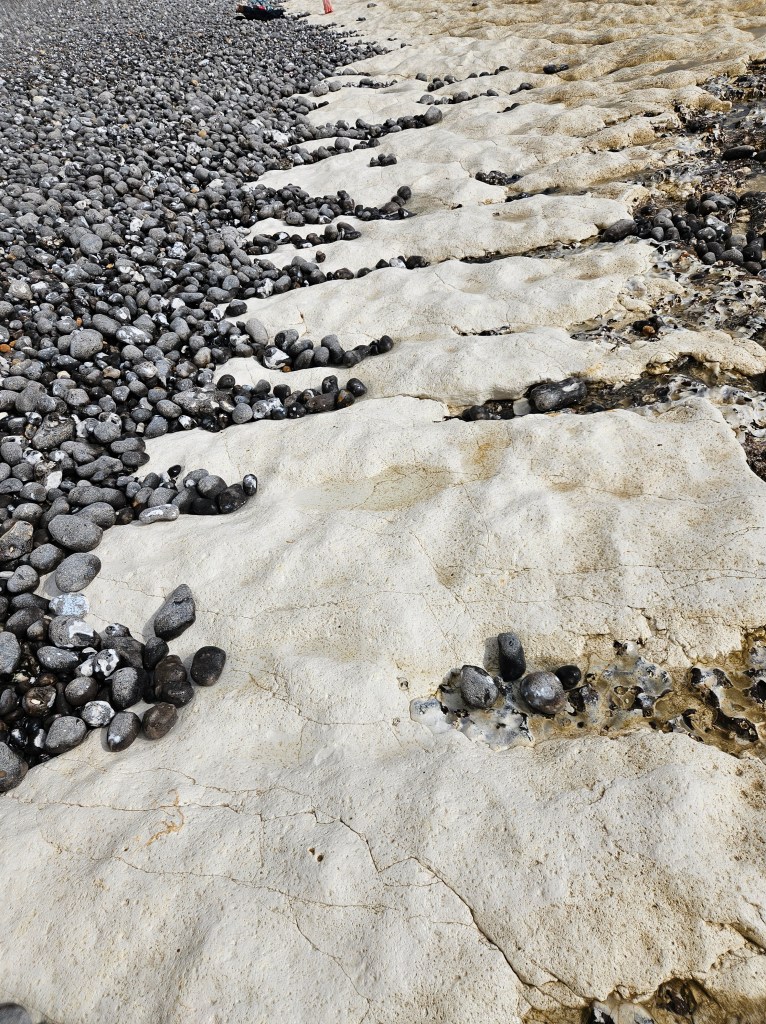
The rock pools and chalk platforms at Birling Gap are also part of the story. At low tide, the sea pulls back and exposes flat, pale chalk shelves, pools of water, seaweed, stones and little pockets of marine life. Fossils occur throughout the chalk too, including ancient sea creatures such as echinoids, sponges and bivalves. (discoveringfossils.co.uk)
That is one of the things I loved about the place before I even decide what I properly think of it. It is not just a “pretty view” stop. It is geology, erosion, fossils, coastline, danger, beauty and deep time all piled into one stretch of beach.
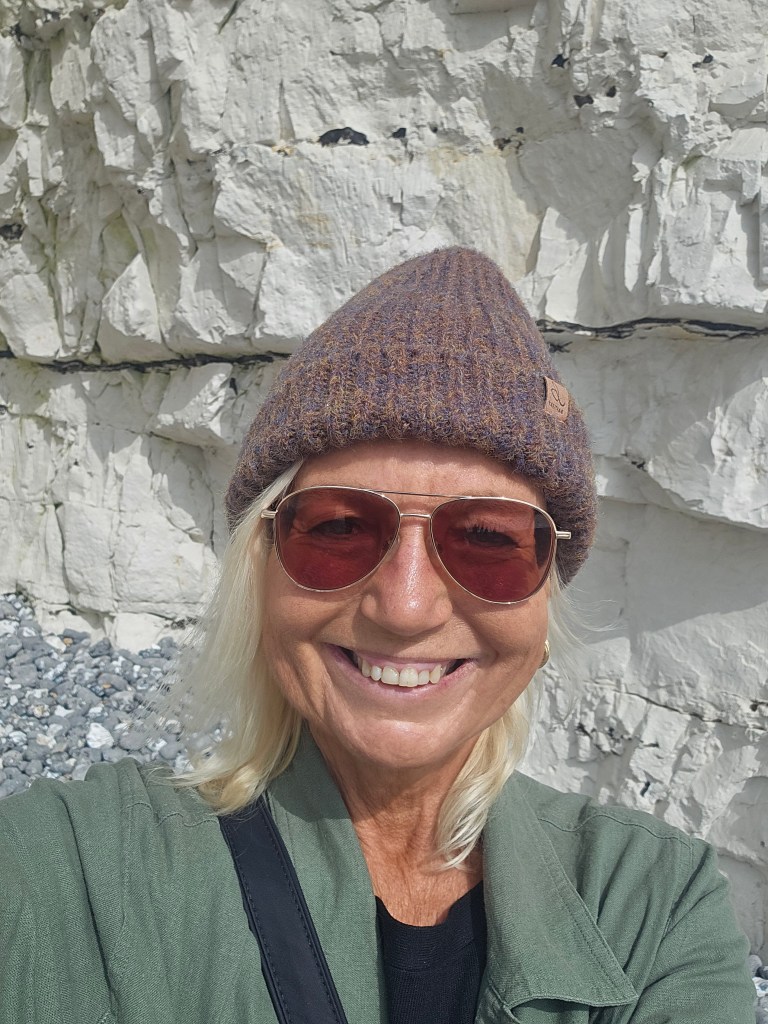
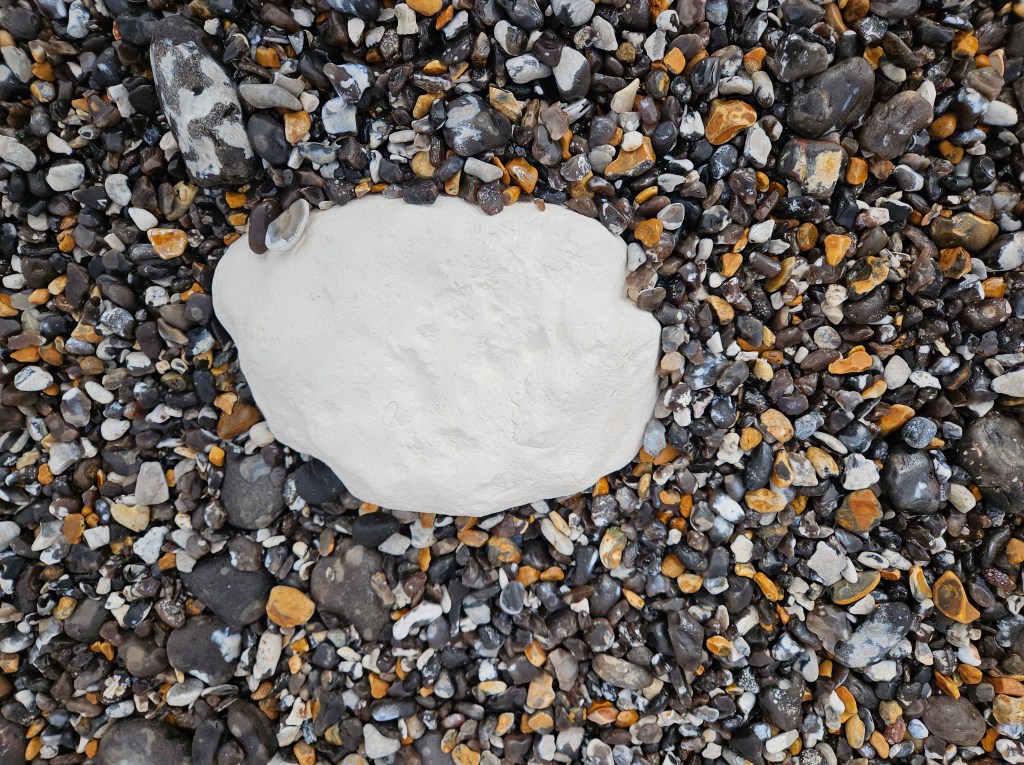
This has so far become one of the highlights of my time in England. To sit on the beach with its absolutley plethora of beautiful marked stones was just devine. We stayed for hours just walking up and down the beaches admiring the cliffs. Looking a piles of chalk that had crumbled away from the cliff.
Picking up a piece of this ancient chalk and writing my name on a rock just made me happy. There were hundreds of people here but the beach is big enough for everyone. You can swim if your are brave enough but note this is not a patrolled beach. But honestly just looking up at the cliffs and imagining them millions of years ago as part of the actual ocean, it makes you feel very small yet somehow deeply connected to the Earth.
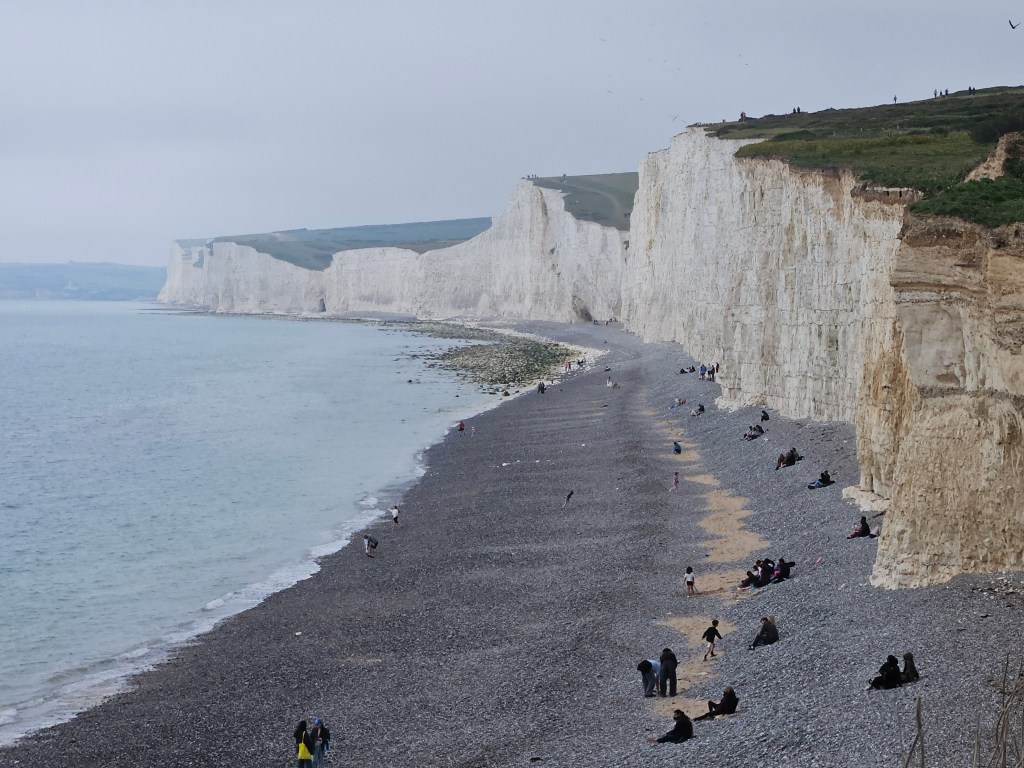
This was about a 90 minute drive from Reigate. You need to pay for parking but the visit to the cliffs is free and I can not reccommend it ebough.
Useful things to know before visiting
Birling Gap has National Trust facilities including parking, toilets, café/shop access depending on opening times, and steps down to the beach. The gift shop has some lovely items to browse. The beach is shingle, not soft sand, so wear shoes that can cope with uneven stones. At low tide you can see more of the rock pools and chalk platform, but tide times matter because access can change quickly.
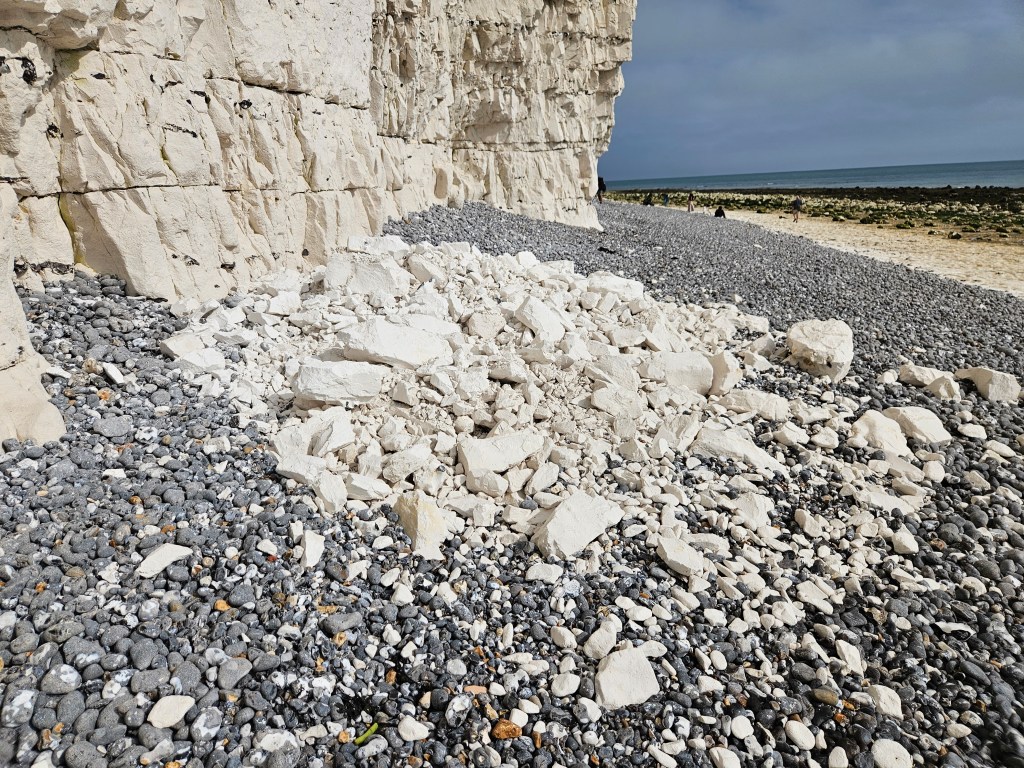
The cliffs are beautiful, but they are not stable. Keep away from the cliff edge and don’t sit directly under the cliff face. That pile of fallen chalk is not decorative. It is evidence.
For me, the Seven Sisters were worth seeing because they are dramatic without needing anything added. No castle. No big attraction nonsense. Just cliffs, sea, rock pools and millions of years sitting there in plain sight.
And honestly, that is enough.
 Roaming Towards Myself
Leave a comment