There are some places you visit because they are famous, and some places you visit because they sound a bit odd and you cannot stop thinking about them.
Royston Cave is definitely the second kind.

From street level, Royston looks like a normal Hertfordshire town. Shops, traffic, pubs, people crossing the road, ordinary everyday life happening above ground. Then you go down a narrow staircase beneath the street and find yourself inside a human-made chalk cave covered in carvings of saints, symbols, figures, crosses and strange little faces that seem to stare back from the walls.
It is one of the most unusual places I have visited so far.
What is Royston Cave?
Royston Cave is a human-made, beehive-shaped chamber cut into the chalk beneath Royston. It sits below the old crossroads of Ermine Street and Icknield Way, two ancient routes that gave the town an important position long before modern roads and traffic lights arrived. The cave is cut about 25 feet into the chalk beneath the town’s ancient crossroads.
That is one of the strangest things about it. From above, it looks like an ordinary town junction. Underneath, there is this carved chalk chamber full of unanswered questions.
The cave does not feel natural. It feels deliberate. Someone made it. Someone shaped it. Someone carved into it. The problem is that nobody knows exactly who, or why.

When was Royston Cave discovered?
Royston Cave was discovered by accident in 1742. A workman was digging in the old butter market area when he found a millstone beneath the surface. When it was moved, it revealed a vertical shaft leading down into the chalk.
That alone sounds like the start of a ghost story.
Once the cave was cleared, the carvings were found on the walls. Some bones and pottery fragments were also reportedly discovered, but a lot of the material removed from the cave was discarded. That is painful to think about now, because modern archaeology might have been able to tell us far more.
What are the carvings?
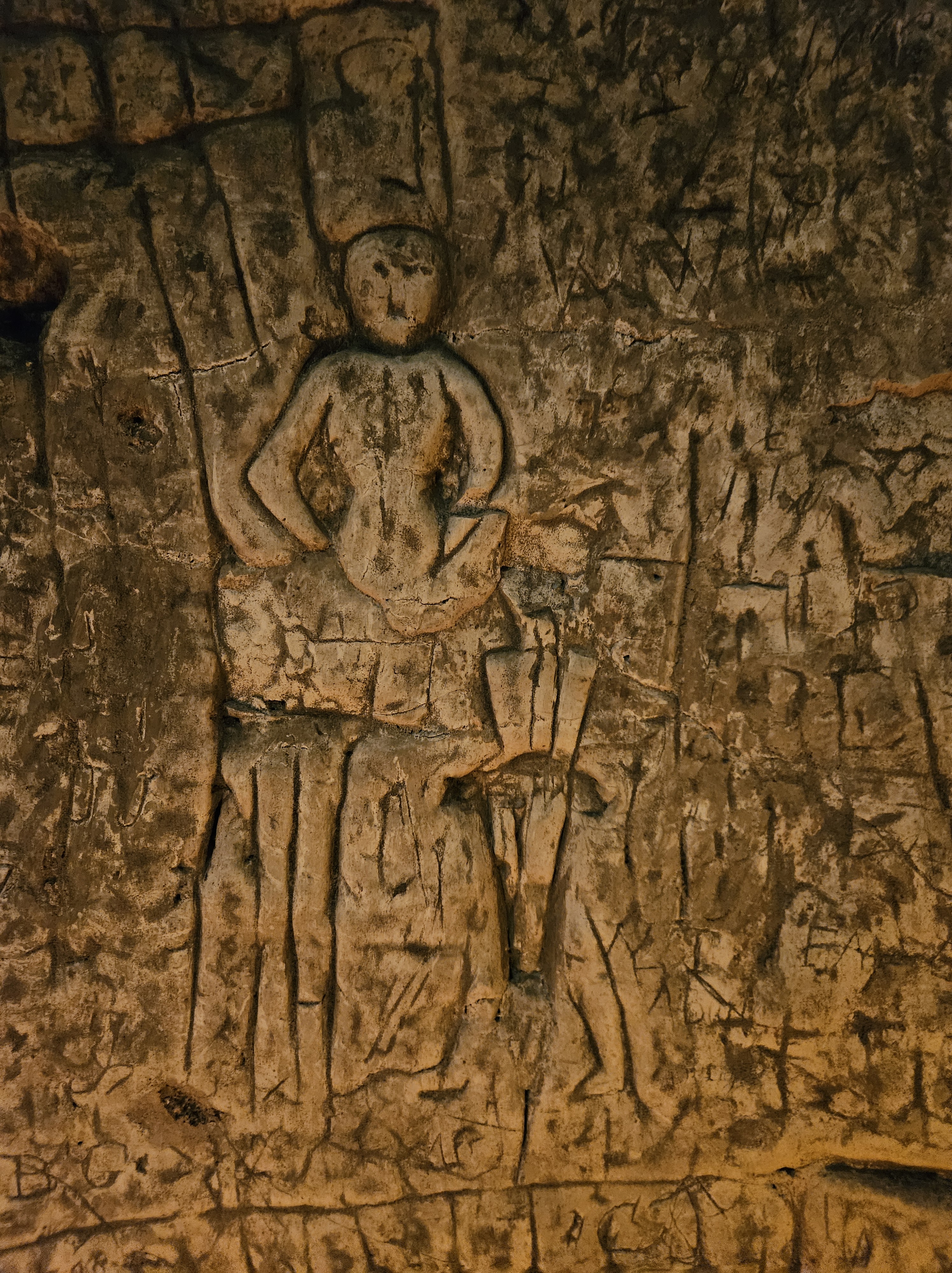
The carvings are mostly religious or symbolic. Some are thought to show Christian figures and scenes, including the Crucifixion, St Catherine, St Christopher and St Lawrence. Other carvings are harder to identify and still leave room for argument.
Standing inside it, the carvings do not feel neat or polished. They feel rough, layered and human. Some are clear. Some are worn. Some look religious. Some look almost childish. Some look like they belong in a medieval church. Others look like someone was down there trying to leave a message.
That is part of the pull of the place. You are not just looking at carvings. You are looking at people from another time trying to say something, and we still do not fully know what.

The ley lines
Our guide also pointed out where the ley lines are said to cross above the cave.
I am keeping this part carefully worded, because ley lines are not an established historical fact in the same way the chalk, carvings and discovery date are. They belong more to the folklore, spiritual and alternative-history side of the cave.
But they are absolutely part of the story people tell about Royston Cave.
The idea is that lines of energy or significance cross at or near Royston, adding another layer to the mystery of why the cave might have been made there. Whether you see ley lines as history, folklore, energy, or simply part of the stories people attach to strange places, it adds to the feeling that people have been trying to explain this underground chamber for centuries.
Standing above it at the road junction, it is odd to think that beneath the traffic lights, shopfronts and normal town life is a carved chalk chamber that still has no agreed explanation.
Who made it?
This is where Royston Cave gets properly interesting.
There are several theories, but no definite answer. Some theories connect the cave with the Knights Templar, others with King James I and the Freemasons. Royston Town Council describes the cave as an enigma and says no records of its age or purpose exist.
The Knights Templar theory is probably the most famous one. It has huge appeal because the cave is underground, mysterious, full of religious carvings and located at an old crossroads. But it is still a theory, not a proven fact.
Other suggested uses include a small private chapel, a quiet religious retreat, or even a place where one person may have lived apart from ordinary life for religious reasons. It may also have been used more practically as a storehouse. Nobody knows for sure.
That is what makes it so good. The cave refuses to sit still in one explanation.

Visiting Royston Cave
The cave is open for public tours from 4 April to 27 September 2026, on Saturdays, Sundays and Bank Holidays. Tours run in the afternoon at 1.00 pm, 1.45 pm, 2.35 pm and 3.20 pm. Entry is by guided tour only, tickets must be booked online, and the tour lasts around 40 minutes.
Current ticket prices are:
| Ticket | Price |
|---|---|
| Adult | £10 |
| Concession, 65+ or student | £8 |
| Child, 3 to 15 | £4 |
| Under 3 | Free |
For me, the £10 ticket was worth it.
It is not a huge attraction in the shiny, polished sense. It is small, underground and slightly awkward to photograph because of the lighting and the shape of the space. But that is also the point. You are not walking through a recreated visitor experience. You are standing inside a genuine historical puzzle.
The walls are chalk. The carvings are strange. The explanations are uncertain. The atmosphere is the best part.
I came out with more questions than answers, which is exactly what I want from a place like this.

Final thoughts
Royston Cave is not just interesting because it is old. It is interesting because nobody can fully pin it down.
It might have been religious. It might have been secretive. It might have been practical and later became symbolic. It may have had several uses over time. The carvings might be medieval, but some could have been added later. The Templar and Freemason theories are fascinating, but not proven. The ley line stories add another layer, but belong more to folklore than firm history.
And yet, standing inside it, you can understand why people keep trying to explain it.
Some places give you facts. Royston Cave gives you candle light, a wall full of strange figures, and a very good reason to keep looking.
Subscribe for free.
Get new posts from Roaming Towards Myself — budget travel, ghost hunting, mental health, moving overseas in your 50s, empty nester life, writing, and starting again.
https://www.cambridge.org/core/books/knights-templar/6FB2D8E32CF97F1F5D6F303EB646450B
Leave a Reply